What if the move that finally gives your family room to breathe does not require leaving Manhattan at all? If you are outgrowing your current apartment and weighing space, schools, parks, and daily logistics, Tribeca often enters the conversation for a reason. You can find larger homes, a distinctive downtown feel, and strong waterfront access, but you also need to understand the pricing, housing types, and school planning that come with the neighborhood. Let’s dive in.
Why Tribeca appeals to upsizing families
Tribeca stands out because it offers something many Manhattan families struggle to find: big residential layouts in a central location. StreetEasy describes the neighborhood as an upscale area of cast-iron lofts and dramatic new buildings, with quiet cobblestone streets and strong subway access.
For many buyers, that combination is the point. You are not choosing Tribeca because it is a bargain. You are choosing it because you want more square footage, architectural character, and a downtown address without giving up Manhattan living.
That premium comes through clearly in the numbers. StreetEasy reports a current median sale price of about $3.5 million in Tribeca, with median base rent around $7,897, which places it firmly in the top tier of family-oriented Manhattan markets.
Space is the real luxury
If your current home feels tight, Tribeca can open up options that are hard to match elsewhere in the city. The neighborhood’s industrial history helps explain why so many homes feel different from standard Manhattan apartments.
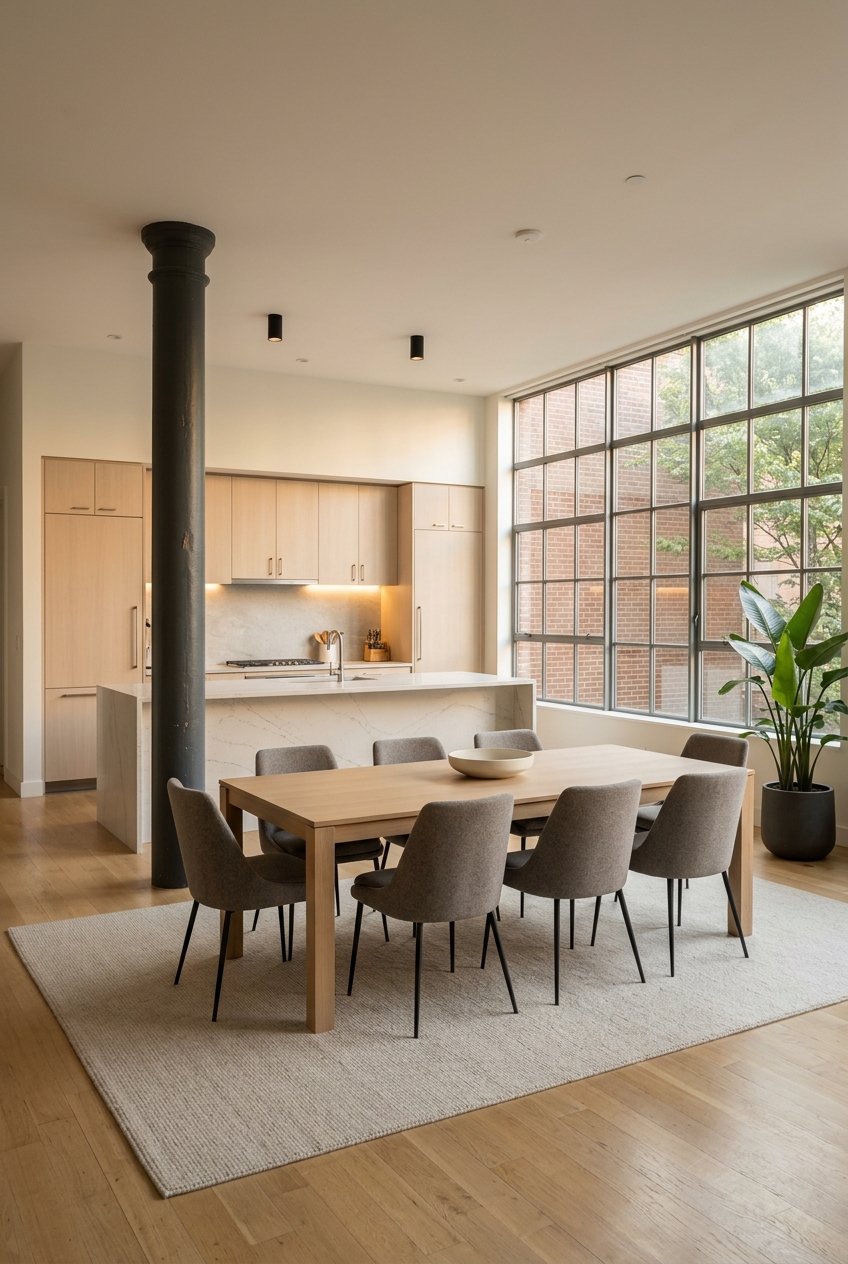
According to the Landmarks Preservation Commission, Tribeca’s historic store-and-loft buildings were developed in the 1850s to create large open interior spaces for storage and commerce. Today, that legacy shows up in wide floor plates, high ceilings, and flexible layouts that often work well for households needing more living, work, or play space.
StreetEasy examples show what this can look like in real terms. Current listings in the neighborhood include a 1-bedroom around 1,100 square feet, 3-bedroom homes around 1,800 to 2,000 square feet, and a 4-bedroom home of just over 4,100 square feet.
For a family trying to stay in Manhattan while moving into a more comfortable long-term home, that matters. In Tribeca, upsizing often means more than adding one extra bedroom. It can mean a home that changes how your day feels.
Lofts vs condos in Tribeca
One of the most important Tribeca decisions is not just whether to buy here. It is what kind of Tribeca home fits your lifestyle.
Loft conversions offer volume and character
Historic loft buildings tend to attract buyers who value scale, ceiling height, and a more distinctive layout. These homes often feel dramatic and open, with architectural details tied to the neighborhood’s warehouse past.
For example, Cobblestone Loft at 28 Laight Street was originally built as a warehouse in 1891 and converted to condos in 2000. It is a full-service building with a roof deck, fitness room, library area, and parking, and its recent sales history includes 3-bedroom homes around 3,214 square feet plus a current 4-bedroom home above 5,400 square feet.
Full-service condos add convenience
Other buyers prioritize service, amenities, and easier daily management. In Tribeca, full-service condo options can offer doormen, fitness centers, roof decks, and parking, along with layouts that still feel generous by Manhattan standards.
River Lofts at 92 Laight Street blends a 19th-century warehouse conversion with a newer 2004 structure. The building offers 24-hour doorman service, a fitness center, a garden, and direct elevator access to the indoor garage, with current 3-bedroom offerings of about 2,071 and 2,200 square feet.
Another example is 415 Greenwich Street, also known as Tribeca Summit, which is presented as a full-service condo with beamed ceilings and a 3-bedroom, 3.5-bath home of about 2,693 square feet. For many families, this is where Tribeca gets especially compelling: you can find substantial space without giving up service and convenience.
Which option works better for your family?
In simple terms, the choice often comes down to your priorities:
- Choose a loft conversion if you want scale, flexibility, and historic character.
- Choose a full-service condo if you want staffing, amenities, and a more managed day-to-day living experience.
- Focus on both if you want the widest search, since some Tribeca buildings blend old and new.
School planning in Tribeca requires precision
For families, school research is often one of the biggest reasons a move feels complicated. In Tribeca, it is especially important to approach this carefully.
Tribeca is in NYC Public Schools District 2, while the Upper West Side is in District 3. That can matter if you are comparing neighborhoods, because school planning in Manhattan is not simply about picking an area and assuming one predictable path.
The key point is this: school assignment here is building-specific. You should verify any exact address in MySchools to understand zoned or nearby programs, rather than assuming every Tribeca address points to the same school options.
Some of the public and early-childhood options families commonly review in and around Tribeca include:
- CPC-Tribeca Early Learning Center at 21 St. John’s Lane, serving 3-K, EarlyLearn, and pre-K
- P.S. 234 Independence School at 292 Greenwich Street, serving K-5
- Spruce Street School at 12 Spruce Street, serving PK-8
- P.S. 89 at 201 Warren Street, serving PK-5
StreetEasy’s page for 415 Greenwich Street, for example, shows that address zoned to P.S. 234 Independence School and M.S. 297. That is a useful reminder that your school search should happen address by address, not neighborhood by neighborhood.
Parks and after-school life in Tribeca
One reason Tribeca works so well for many upsizing families is that it feels more outdoor-friendly than some buyers expect from a downtown neighborhood. If your daily routine includes playground time, after-school energy release, weekend walks, or waterfront outings, the neighborhood offers meaningful access.
Washington Market Park is a 2.15-acre neighborhood park with a playground, tennis court, full and half basketball courts, restrooms, and spray showers. That gives families a practical local option for regular use, not just an occasional destination.
Hudson River Park expands the picture even more. Its Tribeca section includes Pier 25, Pier 26, and the Tribeca Upland, along with a boardwalk through native plants, a dog run, basketball and tennis courts, a children’s playground, mini golf, beach volleyball, a skatepark, and kayaking access.
The Trust describes Hudson River Park as a 550-acre, four-mile riverfront park, and Pier 25 alone is 985 feet long and includes Manhattan’s only 18-hole miniature golf course. For a neighborhood deep in the city, that kind of open-space access can materially improve everyday life.
How Tribeca compares with other family areas
Tribeca is often compared with the Upper West Side, Battery Park City, and Lincoln Square. These comparisons are useful, but they also make one thing very clear: Tribeca is not the value option.
Based on StreetEasy neighborhood pages, Tribeca’s median sale price is about $3.5 million. The Upper West Side is around $1.2 million, Battery Park City around $980,000, and Lincoln Square around $1.3 million.
Rental comparisons tell a similar story. Tribeca’s median base rent is about $7,897, compared with roughly $4,500 on the Upper West Side, $5,250 in Battery Park City, and $5,350 in Lincoln Square.
So why do buyers still choose Tribeca? Because the trade-offs are specific.
- The Upper West Side offers a greener, more easygoing feel and a large prewar housing stock.
- Battery Park City offers a quieter, scenic setting with newer condo inventory and abundant greenspace.
- Lincoln Square offers strong cultural access and a more tower-oriented environment.
- Tribeca offers loft volume, downtown identity, and waterfront access that can be hard to replicate elsewhere in Manhattan.
If your top priority is maximizing value per dollar, another neighborhood may fit better. If your goal is securing more space in a premium downtown setting, Tribeca becomes much more compelling.
What to think about before you move
Before you focus on a specific building, it helps to get clear on your real priorities. In Tribeca, families tend to get the best results when they define what matters most before they start touring seriously.
Start with your non-negotiables
Ask yourself:
- How much usable square footage do you actually need?
- Do you want loft character or a more traditional condo experience?
- Are building amenities like a doorman, gym, roof deck, or parking important?
- How important is address-specific school research in your search?
- Do you want to be as close as possible to the waterfront or parks?
Be realistic about the premium
Tribeca can be a strong lifestyle upgrade, but it comes at a premium price point. Going in with a clear budget and a realistic understanding of what that budget buys in this neighborhood can save time and reduce frustration.
Evaluate the building, not just the unit
In a neighborhood with such a mix of historic and newer housing stock, building-level details matter. The right apartment on paper can feel very different depending on the services, layout style, and overall living experience of the building.
Why Tribeca works for the right buyer
Tribeca is not trying to be every family neighborhood in Manhattan. That is part of its appeal.
It is best for buyers who want to upsize without giving up a downtown lifestyle, and who are willing to pay for space, architecture, and access. For the right household, that can mean a rare mix of larger homes, nearby parks, waterfront recreation, and a distinctly New York sense of place.
If you are comparing neighborhoods, the smartest move is to look beyond broad labels like family-friendly or luxury. In Tribeca, the real question is whether the neighborhood’s combination of scale, services, school logistics, and downtown energy matches the life you want to build next.
If you are considering a move and want a sharper, data-driven read on Tribeca versus other Manhattan options, Elena Smirnova can help you compare buildings, layouts, and neighborhood trade-offs with the kind of detail an upsizing search requires.
FAQs
Is Tribeca a good neighborhood for families who need more space in Manhattan?
- Yes. Tribeca stands out for large-format homes, including lofts and sizable condos, with current neighborhood examples showing 3-bedroom homes around 1,800 to 2,000 square feet and some much larger options.
How expensive is Tribeca compared with other Manhattan family areas?
- Tribeca is a premium market. StreetEasy reports a median sale price of about $3.5 million and median base rent of about $7,897, which is higher than the Upper West Side, Battery Park City, and Lincoln Square.
How do public school options work for Tribeca homebuyers?
- Tribeca is in NYC Public Schools District 2, and school planning should be done by exact address. Families should verify each building in MySchools because assignments and nearby options are not one-size-fits-all.
What parks do families use in Tribeca?
- Families often look at Washington Market Park and Hudson River Park. Local options include playgrounds, basketball and tennis courts, spray showers, mini golf, beach volleyball, a skatepark, and kayaking access.
What is the difference between Tribeca lofts and Tribeca condos for families?
- Loft conversions often offer more character, volume, and flexible layouts, while full-service condos may offer conveniences such as doormen, fitness centers, roof decks, and parking.
Should families comparing Tribeca and the Upper West Side think about school districts?
- Yes. Tribeca is in District 2 and the Upper West Side is in District 3, so the comparison is not just about housing style or location. It also changes the school research process.